Written by Carol Murry

Al Ain Under Curfew
The book, Tale from Under Curfew, was written during a writing workshop for the children of Al Ain refugee camp in the city of Nablus in occupied Palestine. They were born in Al Ain after their families were thrown off their ancestral lands that the children have never seen. They compare the green hills of the villages in Galilee their grandma described to them with the camp where the alleys are so narrow that, when their grandma died, elders had to carry her body from roof to roof to reach the main street. Their grandma’s tales were used to calm them during curfew when soldiers swept into the camp in jeeps and tanks, shouting, throwing tear gas and shooting at them for days and nights.
Another International Women’s Peace Service volunteer and I visited Al Ain with a French volunteer and Reida Masri, administrator of the Local Rehabilitation Committee, working with refugees. Reida focuses on extreme psychological trauma of refugee children due to soldiers coming into their houses at night and keeping the camp under fire for extended periods.
Al Ain Refugee Camp, established by UNWRA (United Nations Relief and Works Agency) in 1947-1950, has a clinic and schools for boys and girls within the camp. The 6,800 residents live under such stressful crowded conditions that fighting is common and 60 are currently in prison. Reida showed us how severely the soldiers had destroyed the structures of the camp, which were covered with graffiti and bullet holes. Any light fixtures were shot and many parts of the structures were completely destroyed. One section of the camp was underground with lighting destroyed by soldiers. Refugees lived underground with no windows in cave-like structures. Sheep were living next to one dwelling in an adjacent structure.
In 2007 Israeli Defense Forces (IDF) and Border Police placed the camp under complete curfew for three days while they carried out a house-to-house search and arrest campaign, during which two Palestinians were killed and 25 injured including two children and one woman. One IDF soldier was killed and 5 injured, including 4 by a tear gas canister exploding prematurely inside their armored vehicle. They reportedly shot and killed a crippled man, would not allow the ambulance in to treat him, and shot the driver in the hand while he was trying to treat people. In times such as these, their grandmas told them tales of villages they had never seen.
The maze of narrow alleys of the camp is indeed too narrow to carry their grandma through. The sun barely reached the ground. At the first place we visited, the mother had gone to visit her son who had been in an Israeli prison for 13 months on administrative detention, meaning that there were no charges or trial. She was the only family member allowed to visit and had to leave the house at 4am to reach the prison. She was not allowed to bring anything to her son except money so he could buy Israeli products in the prison store.
Political Prisoners
Addameer Prisoner Support and Human Rights Organization reports that Israel was holding 4,596 Palestinians political prisoners in October 2012, including 184 in administrative detention, and 189 children – most for expressing opposition to the occupation. Among all Palestinians, 25% have been imprisoned and 40% of Palestinian males. Family visits, if not denied, are allowed only once every 3 months for 45 minutes. Israeli prisons are known for physical abuse, appalling conditions, medical negligence, and torture, including for children as young as 12. The youngest prisoner was beaten, placed in solitary confinement, sexually assaulted, and tried to commit suicide twice.
Psychological Trauma
In the next place, Reida knocked and then opened the door as she explained that the girl in that place had become “crazy” due to fear. The Committee had built a wall so that the family had a living room with a small door at floor level, which, when opened, revealed only the feet of the girl who was hiding underground and covered with a blanket. The family has no money to get treatment for her. Medecins Sans Frontieres (MSF) and Palestine Treatment and Rehabilitation Center for Victims of Torture (TRC) report increased numbers of children with PTSD and other anxiety disorders. Over half the cases they treat in Nablus are severe enough to affect daily functioning with over 40% of all patients experiencing anxiety related to settler harassment and military incursions. One eight-year-old girl developed bed-wetting, stuttering, and lost weight after being pulled away by her hair by soldiers as she tried to hold her father’s legs while he was being forcibly arrested.
We then stopped at a place where the young woman served us juice and then described how Israeli soldiers had shot across her pregnant abdomen from one side to the other when she was ready to deliver a baby girl. The shot killed the infant but the soldiers refused to allow her to go to the hospital for 2 hours. Her husband was also shot and is still recuperating after several surgeries. She then pulled out her cell phone and showed us photos she had taken of the dead infant who appeared to be fully formed with fatal traumatic injuries.
“One Shot-Two Kills”
This type of IDF cruelty was reported to be common. The BBC News reported in March 2009 that Haaretz Daily confirmed the production of customized t-shirts, including one that showed a sniper’s crosshairs over a pregnant woman’s abdomen with the caption, “ONE SHOT-TWO KILLS”. An IDF psychologist was reported as saying soldiers were allowed to wear them in private and in the barracks to promote bonding within a small unit. In the same article, soldiers were quoted as saying they killed Palestinian women and children by opening fire in haste under relaxed rules of engagement in Gaza. Another indication of aggression toward childbearing Palestinian women is documentation by the Palestinian Ministry of Health that between 2000 and 2007, 10% of Palestinian women were forced to endure labor or childbirth at a checkpoint. Lancet reported that this cruel practice resulted in at least 35 deaths of infants and 5 women during that period.
The Destruction of Nablus
As we returned home walking through the souk, or market, on our way to the bus station, we passed through an area where the soldiers had destroyed as much as they possibly could of the old city of Nablus during 2002. Israeli military forces had carried out an 18-day air and ground bombardment of Nablus, destroying about 400 structures in the Old City where approximately 23,000 Palestinians lived. During the second invasion of Nablus, its residents were placed under 24-hour curfew for more than 100 consecutive days and another 1,200 structures were damaged. Shortly thereafter another 592 buildings were damaged.
During the 2012 Russell Tribunal on Palestine, some presenters described sociocide as the attempt to destroy a people, its dignity, culture, and any trace that it had ever existed in the land. The destruction of the old city of Nablus, coupled with imprisonment, terrorism of children and cruelty and slaughter of women and children appears to constitute sociocide. Israeli oppression is compounded by chronic unemployment, overcrowding, and an old infrastructure in urgent need of maintenance and repair. Luckily the children of Al Ain continue to exist and to speak out, even under curfew and terrorized, bravely refusing to let the stories of their ancestral villages die. But all Palestinian people, including 5.5 million refugees housed around the world and the 6,800 residents of Al Ain deserve to live lives of peaceful sleep and play with adequate food and water and health care and intact families – and to reclaim their ancestral lands without being exiled, arrested, harassed, terrorized, tortured, killed by IDF soldiers or treated as nonhumans. All of us must ensure that our governments and the United Nations are not complicit in the attempted sociocide in Palestine.
From In Occupied Palestine – November 6, 2012
- Israeli Army shells refugee camp – serious injury
- Israeli Army opens fire on Palestinian fishing boats – one boat hijacked
- Israeli Army destroys West Bank village irrigation system
- Israeli Army orders destruction of solar electricity panels, school classrooms and a clinic
- Israeli troops pour scalding coffee in man's face
- Serious injuries as Occupation settlers force olive harvesters off the land
- Raiding Israeli troops detain 8-year-old boy
- Israeli Army destroys West Bank villager's home
- 14-year-old boy beaten and hospitalised by Israeli troops
- Israeli soldiers abduct 4 youngsters aged 16 to 17
- Night peace disruption and/or home invasions in 24 towns and villages
- 4 attacks – 39 raids including home invasions
- 7 beaten – 11 injured
- 7 acts of agricultural/economic sabotage
- 24 taken prisoner – 20 detained – 104 restrictions of movement
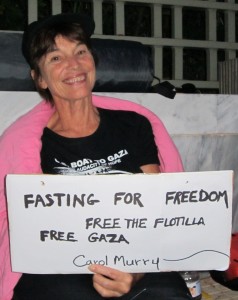
Carol Murry lived and worked in rural Bangladesh, Thailand and Swaziland; started a community health worker program on Micronesian outer islands; did leprosy research in Bhutan; directed NGOs; was University of Hawai’i faculty; and researched HIV among Pacific Island youth for UNICEF. She was one of the passengers aboard "The Audacity of Hope" in July 2011 as part of the international flotilla, Stay Human. When the flotilla and her captain, John Kluismire, were illegally detained Carol fasted for days, until her captain was released.
She can be reached at: [email protected].