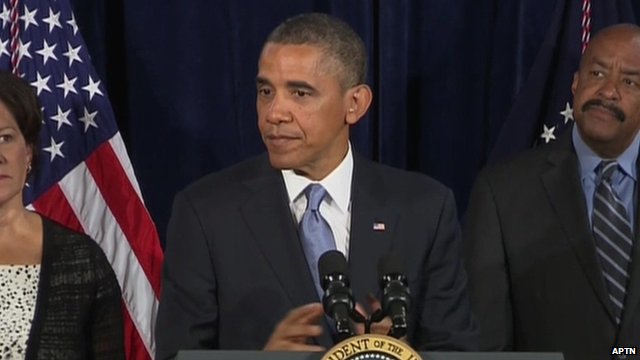
Barack Obama: "You can't have 100% security and also then have 100% privacy and zero inconvenience"
President Barack Obama has defended newly revealed US government phone and internet surveillance programs, saying they are closely overseen by Congress and the courts.
Mr Obama said his administration had struck "the right balance" between security and privacy.
He also stressed US internet communications of US citizens and residents were not targeted.
And he tried to reassure the US "nobody is listening to your phone calls".
Mr Obama was commenting on revelations this week in the Guardian and Washington Post newspapers that the US National Security Agency (NSA) was collecting or tapping into vast amounts of telephone and internet communications data.
'Healthy skepticism'
The news accounts - subsequently confirmed by officials - roiled Washington DC, with privacy advocates criticizing the surveillance as an unlawful intrusion and many in Congress defending the programs as appropriate counter-terrorism tools.
On Wednesday night, the UK's Guardian newspaper reported a secret court had ordered phone company Verizon to hand over to the NSA millions of records on telephone call "metadata".
That report was followed by revelations in both the Washington Post and Guardian that the NSA tapped directly into the servers of nine internet firms including Facebook, Google, Microsoft and Yahoo to track online communication in a program known as Prism.
And on Friday, the Guardian reported that the UK's electronic surveillance agency, GCHQ, had been able to see user communications data from the American internet companies, because it had access to Prism.
The Guardian reported that GCHQ had access to the system since June 2010 and information from Prism had contributed to 197 British intelligence reports last year.
In California on Friday, Mr Obama noted both NSA programs had been authorized repeatedly by Congress and were subject to continual oversight by congressional intelligence committees and by secret intelligence courts.
The president said he had come into office with a "healthy skepticism" of both programs, but after evaluating them and establishing further safeguards, he decided "it was worth it".
"You can't have 100% security, and also then have 100% privacy and zero inconvenience," Mr Obama said.
Acknowledging "some trade-offs involved", he said, "We're going to have to make some choices."
Senior US Senator Dianne Feinstein confirmed on Thursday that the Verizon phone records order published by the Guardian was a three-month extension of an ongoing request to Verizon. Intelligence analysts say there are likely similar orders for other major communications firms.
The data requested includes telephone numbers, calling card numbers, the serial numbers of phones used and the time and duration of calls. It does not include the content of a call or the callers' addresses or financial information.
'Assault on Constitution'
Prism was reportedly developed in 2007 out of a program of domestic surveillance without warrants that was set up by President George W Bush after the 9/11 attacks.
Prism reportedly does not collect user data, but is able to pull out material that matches a set of search terms.
James Clapper, director of US national intelligence, said in a statement on Thursday the internet communications surveillance program was "designed to facilitate the acquisition of foreign intelligence information concerning non-US persons located outside the United States".
"It cannot be used to intentionally target any US citizen, any other US person, or anyone located within the United States," he added.
But while US citizens were not intended to be the targets of surveillance, the Washington Post says large quantities of content from Americans are nevertheless screened in order to track or learn more about the target.
The Prism program has become a major contributor to the president's daily intelligence briefing and accounts for almost one in seven intelligence reports, it adds.
Mr Clapper said the program, under Section 702 of the Foreign Intelligence Surveillance Act, was recently reauthorised by Congress after hearings and debate.
In Congress, reaction to the revelations was split.
"When law-abiding Americans make phone calls, who they call, when they call and where they call from is private information," said Democratic Senator Ron Wyden.
"As a result of the disclosures that came to light today, now we're going to have a real debate in the Congress and the country and that's long overdue."
Republican Senator Rand Paul called the programmes "an astounding assault on the Constitution''.
But his colleagues Republican Senator Lindsay Graham and Democratic Senator Dianne Feinstein both defended the phone records practice on Thursday.
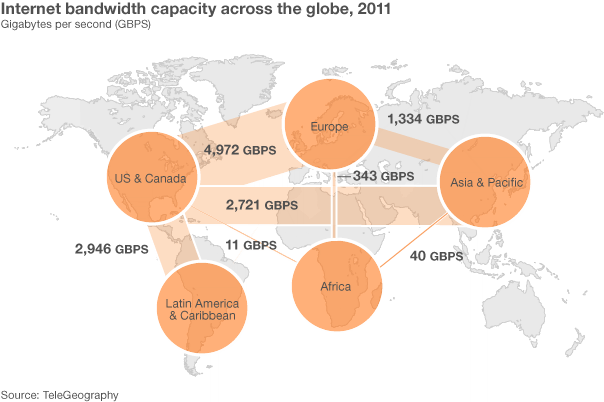
Internet bandwidth capacity across the Globe, 2011
Gigabytes per second (GBPS)
WHAT THE PAPERS SAY
- The Washington Post says one of the many things still unclear about the phone surveillance programme is why Americans didn't know about it. In an editorial, the paper says the public needs more explanation to be able to make a reasonable assessment of whether such programmes are worth the security benefits.
- The New York Times says President Barack Obama "is proving the truism that the executive branch will use any power it is given and very likely abuse it". The Patriot Act should be sharply curtailed if not repealed, it says.
- The Los Angeles Times says this week's disclosures underscore how US intelligence and law enforcement now "secretly glean vast amounts of information from communications technology".
- The San Francisco Chronicle says the collection of phone records "conducted with only the barest legal oversight" is "another policy disappointment from a president who came to office promising to ease the worst of the panicky, ill-considered policies launched after the Sept. 11 attacks 13 years ago".
What can you learn from phone records?
US media review: NSA revelations
Listen to Obama's attempt to justify survelliance.
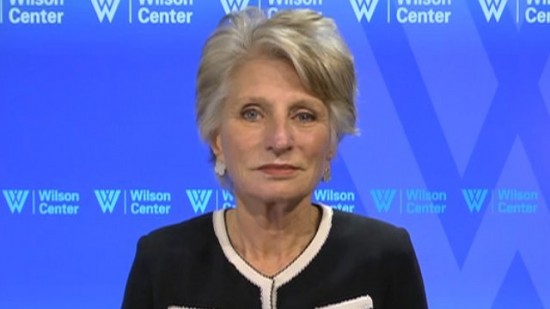
Listen to Ex-congresswoman, Jane Harman, defend US surveillance programmes.
Analysis
 Paul Adams Washington, United States
President Obama said he experienced some "healthy skepticism" about some of the national security operations he inherited when he took office. He's hardly the first American president to realize that it's easier to stick to your core principles outside the White House than inside.
But after managing to keep words like Prism out of the public eye for one and a bit terms, he's having to grapple with how to explain some scary-sounding stuff to the American public.
He still believes that he's successfully navigated between the requirements of security and the need to uphold the Constitution, even if he admits that there are "trade-offs." Those trade-offs have been the subject of rumor and speculation for years but are now glaringly apparent. Mr Obama says he welcomes the debate.
 Rory Cellan-Jones, Technology correspondent
What this highlights is the way we now entrust our data and our privacy almost entirely to American companies, storing it in their "clouds" - vast data centers located in the US.
This article was first published at BBC News US & Canada