
In fact, the scene — an opening at the Ayyam Gallery for the artist Abdullah Murad — was not taking place in a Western capital of the avant-garde but quite the opposite: Damascus, the remote and ancient capital of Syria. And it was a scene that is becoming increasingly common as the city evolves from artistic backwater into a thriving hub of contemporary Middle Eastern painting.
Visitor disbelief is understandable. As the world’s oldest continuously inhabited metropolis, Damascus has long been famous for its ancient appeals rather than contemporary creations: Roman ruins, medieval mosques, Ottoman-period minipalaces, Christian and Islamic lore. The graves of both John the Baptist and the martyr Hussein, grandson of Mohammed, are in the Umayyad Mosque here.
For a long time, the torch of Syrian contemporary art was carried primarily by pioneers like Mustafa Ali, the sculptor whose ramshackle courtyard mansion showcases his moody faces in wood and bronze, and Mona Atassi, the irrepressible director of the Atassi Gallery.
But as the international art world has turned its spotlight on the Middle Eastern market in recent years — Sotheby’s, Christie’s and Bonham’s have established regional headquarters in Dubai — the art scenes in Syria, Lebanon and Jordan have flourished.
Galleries with international ambitions have sprouted to recruit and exhibit local talents. Artists’ profiles have steadily surged, to say nothing of their prices. The only major restriction is that artists must be careful to avoid political subjects in this police state. “No one dares” critique the government, one gallery employee whispered.
The Ayyam Gallery has led the charge. It was started by Khaled Samawi, who abandoned a successful banking career in Switzerland to open the gallery in 2006. With his wife and partner, Jouhayna, he has signed up top locals like Safwan Dahoul, who does a Middle Eastern take on Art Deco, and has opened branches in Dubai, Beirut and Cairo. Ayyam also takes part in fairs in Miami, New York, Paris and beyond.
“It’s the European concept of a gallery,” Ms. Samawi said. “We take an artist and go all the way with him.
We have a lot of potential here in Syria, a lot of good artists. We just need to put them on the map.”
The efforts appear to be paying off. International institutions and collectors have visited for closer looks, she said. “We had some visits from people at the Guggenheim. The Tate came also. Here, to Damascus. Can you imagine?”
A few blocks away, the gallery Tajalliyat has emerged as another top talent incubator since opening last year. On a balmy afternoon the staff was preparing for a show by the Syrian painter Fares Garabet. A dark canvas hung on one wall; it was divided into rectangular panels of gauzy images that recall the Shroud of Turin.
The gallery’s marquee artist is the late Fateh Moudarres, a pioneering 20th-century expressionist and surrealist whom the gallery’s co-owner, Edward el-Shaer, began collecting decades ago.
“When I started my first gallery, in 1985, nobody was interested in art and I couldn’t make any money at it,” said Mr. Shaer, whose family comes from the city of Maaloula. He bought his first Moudarres painting for about $125. Now it’s worth “around $300,000.” Charles Saatchi has one in his collection, Mr. Shaer said, and auction houses like Christie’s and Sotheby’s had been through to have a look. “Now a lot of foreigners are coming to Syria to buy.”
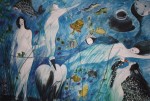
The Damascus art boom can be seen beyond the galleries. Art hotels, once unheard-of here, have begun to sprout. At the year-old Hanania Boutique Hotel, walls are decorated with drippy, brooding portrait paintings by Hala al-Faisal. (The artist attracted notice in 2005 when she was arrested for protesting the U.S. war in Iraq by stripping naked in New York City, where she lives, to reveal body paint that read “Stop the War.”) The Art House Hotel is in a centuries-old castle-like building filled with vaulted stone passageways, studded wooden doors, huge candelabras and other Mideast-Gothic hybrids. You expect to be greeted by Vincent Price. Instead, you are greeted by Ghiath Machnok, the architect and curator.
“Art comes before everything in my life,” he said as he gave a tour of the hotel’s 10 rooms and exhibition area. Nearly every free spot of the building is covered in dark, brooding creations by Syrian artists, especially Sabhan Adam, who creates canvases of monstrous, blood-splattered humanoid creatures. “He’s my favorite,” Mr. Machnok said.
Mr. Adam seems to be everyone’s favorite — or least favorite — Syrian artist, partly through the force of his work and partly through his aggressive marketing. He has taken out magazine ads to trumpet his work and has bought space on billboards along highways that show himself, paunchy, balding and 40-something, posing in a white suit.

Visitors to his very black, very sleek apartment are met with a shower of rose petals and the offer of a drink from a well-stocked bar. Decorative knickknacks like large fake gems, cow skulls and musical instruments adorn the walls, along with many paintings of Mr. Adam’s trademark faces and heads.
“They are the suffering people, the people in pain, the lonely people,” said Mr. Adam through his wife, Ola Taj, who studied English literature and serves as his translator. He said he grew up poor, had no formal art training and used to sell cigarettes on the street to make money. “If I wasn’t an artist, I would be a criminal or a thief,” he said.
Mr. Adam said he found inspiration in the work of Francis Bacon and Egon Schiele. The characters in his paintings, he said, were not supposed to be Syrian or Middle Eastern but universal. “I want all people to understand that this is their reality and their suffering. I want people to see these as their insides.”
The scope of Mr. Adam’s popularity, which is starting to extend beyond the region, offers proof that his message is coming through. “At the beginning, my paintings really troubled people,” he said, sipping a glass of tea as evening descended outside. “Now people love to have them.”
This article was first published at The New York Times.