"He [the native] of whom they [the settler] have never stopped saying that the only language he understands is that of force, decides to give utterance by force. In fact, as always, the settler has shown him the way he should take if he is to become free. The argument the native chooses has been furnished by the settler, and by an ironic turning of the tables: it is the native who now affirms that the colonist understands nothing but force. The colonial regime owes its legitimacy to force and at no time tries to hide this aspect of things.”
~ The Wretched of the Earth
Taken from the chapter entitled “Concerning Violence” in Franz Fanon’s seminal work on anti-colonial struggle The Wretched of the Earth, the above passage describes the point at which the native realizes that the only way to achieve the decolonization he seeks is to answer the colonist in his own tongue. To break free of the colonial yoke, the native must co-opt the language “furnished by the settler” and turn it against him. To Fanon in the context of the colonial occupation of Algeria, this meant answering the violence of the French against the Algerian natives with violent revolution. This, he argued, was the only argument the French understood and therefore the only way to convince them to leave.
The Israeli occupation and colonization of the Palestinian territories has also asserted itself in the language of force. But the language of force it speaks seems to have many dialects. The dialect that most recently and most loudly spoke to the Palestinians was the high pitched, whining tongue of the drones that hummed, with a distinct American English tinge, over Gaza in November of 2012. That language, combined with the stuttering, shouting vernacular of the munitions they rained down on Gaza over that week in November, took the lives of 160 Palestinians, most of whom were civilians. That language was answered in turn with armed resistance from Gaza. But the language of the Israeli occupier does not always shout. Perhaps more often the force of the occupation is expressed in a quiet, legalistic whisper that sweeps from the South Hebron Hills, through Jerusalem and up to Jenin, demolishing, dispossessing and dispersing as it goes. This is the dialect that takes Palestinian homes and land for the building of the separation wall and settlements. It is the tongue that tries to change the facts on the ground, by moving Israeli citizens to Palestinian territory. It tries to permanently alter the landscape of the Palestinian territories through settlement construction in order to convince the world that the West Bank belongs to the state of Israel.
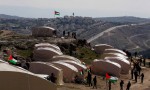
The latest vignette penned in this dispossessing vernacular was the one that promised to build houses for settlers in the E1 section of Jerusalem as punishment for the Palestinian bid for statehood at the United Nations. The zone sits between Palestinian East Jerusalem and the Israeli settlement of Ma’ale Adumim. To build here would cut the northern half of the West Bank from the southern half and would make the dream of a contiguous Palestinian state impossible. It seems, however, that Palestinians have learned enough of this language to begin to use it themselves. Palestinian activists have drawn from the repertoire of the settler to stage a creative protest. Just as settlers drove to hills in the West Bank in mobile homes to start outposts with an eye at proving the Jewish character of the land, Palestinians have pitched tents in E1, thus creating the village of Bab al-Shams (Gate of the Sun). The clear goal, taken right from the notebook of the settler, is to prove Palestinian ties to the land by building on it. They are asserting Palestinian facts on the ground. The difference here, however, between the Israeli settler that establishes a settlement in the West Bank and the Palestinians living in Bab al-Shams is that the Palestinians are building on land they legally own.
Although Israeli Prime Minister Netanyahu wasted no time in calling for the evacuation and demolition of Bab al-Shams, careful planning by the founders of the village has made this easier said than done. Because the tents were built on Palestinian land with the approval of the owners, it is unclear if the state has the right to demolish them. The activists and the owners of the land have successfully petitioned the Israeli High Court for a temporary injunction against the demolition of the village. The injunction is only in effect for a few more days so the long term future of Palestine’s newest village is in doubt. Even if it does get demolished, however, the effects of this protest will be lasting. It seems that Palestinians are getting more and more fluent in this language “furnished by the settlers” and Israel is going to have its hands full dealing with that.
 Matthew DeMaio, from West Hartford, Connecticut, is a senior and an Islamic Civilizations and Societies major at Boston College, currently writing his thesis on the nationalist political discourse of Palestinians and Israelis since 1967. He hopes to work in the field of education in vulnerable communities upon graduating from university.