“I don't know what else to say. I think we are going to die. It makes me sad that I cannot protect the child I made, I can't protect him from these missiles. I just can't. I don't have the superpower to end this madness.”
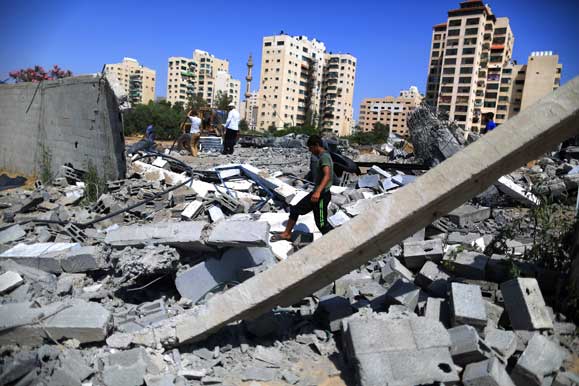
July 9, 2014: I am writing this as ambulance and rescue crews continue to search for bodies. Among the ones they have uncovered so far are those of 4-year-old Mohammed Nawasra, whose body was found underneath the ruins of his home in the Maghazi refugee camp in the central Gaza Strip, his 5-year-old brother, Nidal, and their 29-year-old mother, Sumoud Nawasra. Miriam Nawasra, 83, and Khalaf Nawasra, 29, were found alive, but critically injured. The Nawasra house in Maghazi refugee camp was targeted by an Israeli F-16 missile. No one knows why. Their home was bombed at 5:30 a.m., as the family slept.
Most of the stretchers rescue workers carried into Gaza’s hospitals were filled with arms, legs and scattered pieces of human torso and flesh, torn into pieces by Israeli missiles.
Gaza is currently enduring one of Israel’s heaviest bombings. In the last hour, during and after Iftar, the meal breaking the daily Ramadan fast, 80 air strikes were launched on Gaza, according to Israeli sources. These strikes targeted homes, streets, schools, mosques, governmental buildings, greenhouses and agricultural fields.
The number of people killed grows relentlessly. According to Palestinian Interior Ministry spokesman Iyad Al Bizm, as of today 192 of the injured are children and women, and, in addition to the Nawasra family home, 63 others have been bombed. The list of casualties changes by the minute. [The BBC reported July 10 that as of 10:35 a.m EDT, 80 Gazans have been killed and 540 injured.] The Interior Ministry stated that Israel has launched 780 Israeli air strikes on Gaza. Every few minutes throughout the Gaza Strip one hears the resulting explosions.
As I write this, the Israeli Military has suggested a ground operation may be imminent. Indeed, troops and weapons have been assembling on the border. Israel’s navy has joined the battle as well, and is shelling Gaza from the sea. At this very moment I can hear missiles fired from Israeli warships hitting the homes and fishing boats of Palestinian fishermen.
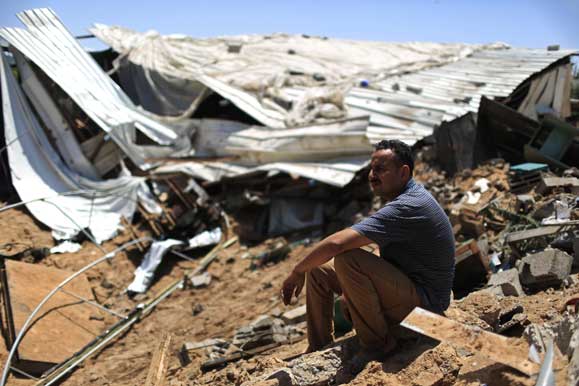
Palestinian man is sitting on the ruins of what remains from his farm in Gaza City after Israeli airstrike overnight
In Gaza we all suffer from Post Traumatic Stress Disorder (PTSD)—it comes with the territory, our territory, that Israel attacks so violently. I don’t want my son to have PTSD. He doesn’t deserve that; he is a child, our gift.
Now, however, F-16s pound Gaza as drones buzz overhead and Israel’s “Operation Protective Edge” continues. There is no moment of relief or rest for anyone trapped in Gaza, as Israeli bombs target yet another neighborhood—God help its terrified residents.
As I write this, news arrives of a group of teenagers killed while watching the World Cup match between the Netherlands and Argentina: 6 boys dead and more than 10 injured by a missile which struck the café on the beach in Khan Younis where, like soccer fans around the world, they were watching the game.
Now a haze of smoke arises from nearby buildings struck by Israeli missiles. One thing I do know for sure is that American-made F-16s are sucking the air—and life—out of the lungs of my family and neighbors in Gaza. No sirens, no shelters, no bunkers, no womb to hide in. Only the dead are safe and at rest.
I don't know what else to say. I think we are going to die. It makes me sad that I cannot protect the child I made, I can't protect him from these missiles. I just can't. I don't have the superpower to end this madness.
This article was first published at Washington Report.
Please Take Action Today!
Sign the Move On Petition and contact your representatives to stop the bloodshed caused by U.S. made and funded weapons.
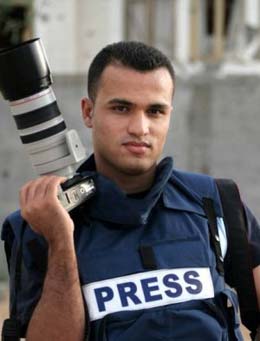 Mohammed Omer (born 1984) is a Palestinian journalist. He has reported for numerous media outlets, including: the Washington Report on Middle East Affairs; Al Jazeera; New Statesman; Pacifica Radio; Electronic Intifada; The Nation; Inter Press Service Free Speech Radio News; Vermont Guardian; ArtVoice Weekly; the Norwegian Morgenbladet; and Dagsavisen; the Swedish dailies Dagen Nyheter; and Aftonbladet; the Swedish magazine Arbetaren; the Basque daily Berria; and the German daily Junge Welt; and the Finish magazine Ny Tid. He also founded the Rafah Today blog. In 2008, Omer was awarded the 2007 Martha Gellhorn Prize for Journalism. In the award citation, Omer was honored as "the voice of the voiceless" and his reports were described as an "humane record of the injustice imposed on a community forgotten by much of the world.". He was also awarded the Ossietzky Prize by Norwegian P.E.N in 2009.
I first became acquainted with Mohammed Omer's work through journalist Dahr Jamail. These two world renown journalists were co-recipients of the 2007 Martha Gellhorn Prize for Journalism. Returning from his European speaking tour Mohammed was detained, interrogated, strip searched and tortured by Israel's Shin Bet and border officers at the Allenby Bridge Crossing in the Occupied West Bank between Jordan and Israel. Students and I, through University of California Santa Cruz participated in an international campaign demanding appropriate medical treatment for Mohammed's severe medical injuries.
It pains us all to see him, his family, and fellow Gazan's suffer ongoing trauma in violation of international and human rights law. ~ Debra Ellis